Extraordinary Capability. Catastrophic Blind Spot.
Why you and Tiger Woods keep on fucking up.
The Switzerland Method
To Resolve Internal Conflicts Causing External Problems
You’ve built something real — a team, a company, a system that touches thousands or millions of lives.
But the man the world sees and the man you actually are?
Not the same.
Worse, you're not seeing what is in your blindspot.
That gap is bleeding into your decisions, your people, and the air everyone has to breathe.
You’ve seen the pattern.
Tiger. Lehman. Boeing. Presidents who couldn’t admit they were wrong.
Extraordinary capability on the surface, catastrophic blind spots underneath.
The same thing is running inside you:
A Forged Identity. Can perform under any pressure.
A Default Identity. Still carries old fear and ego.
A Core Identity. Quietly keeps saying, "This isn't who I am."
That conflict doesn’t stay personal when you’re operating at scale. The blind spot becomes the culture. The culture becomes the system. The system shapes the world.
The Switzerland Method exists to close that gap — first in you, then in the organization you lead.
What This Is
The Switzerland Method is a year‑long partnership for high‑performing men and their leadership teams who are done managing the gap between who they’ve become, what they’re building, and who they actually are.
We don’t stack more performance hacks on top of a broken identity.
We locate your Core Identity, write a Code that actually holds at 2 AM, and then align you and your company to it — so your people aren’t forced to operate in the fallout of your misalignment.
The Work In 4 Moves
1. Locate Your Core Identity
We go back to your own “where I began” moment — the version of you that was absolute before the performance started. We map your three identities (Core, Forged, Default) and see exactly which one is running your life and company right now.
2. Develop Your Code
We turn your Core Identity into a simple, operational Code: what you must do and what you must never do. Then we translate it into a handful of “No Matter Whats” for your team so your culture stops guessing what you stand for.
3. Daily Calibration
You adopt a lean daily check that keeps you honest about who is in command when the pressure hits. In parallel, your key people get simple rituals that shift decisions from fear and optics to Code‑driven behavior.
4. Weekly Accountability
Once a week, we look at evidence, not intentions. Where did you and your leadership live from Core? Where did Forged or Default take over? We adjust behavior and structure until your company lives and breathes the same Code you do.
Who This Is For
Men who have already built something significant— and know their success is now running on an outdated operating system.
Leaders whose blind spot is no longer private; it’s baked into their culture and systems.
Men for whom the cost of pretending is finally higher than the cost of changing.
What Happens Next
This starts with a conversation. You tell me the truth about where you are and what it's costing you. I show you what is in your blindspot. Together we resolve how to close the gap for yourself and for your team.
If it's a fit, we'll both now. If it's not, I'll tell you. Either way, the place to start is to simply book the call.
Or, if you're the kind of man who reads 50 pages before making a decision, below you can read the full manifesto – The Code For Men Who Rule World.
HERE'S THE THING...
When you can't even trust yourself, how can you be certain what to do?

Let's face it. Sometimes life is hard. Sometimes all we want is simply to escape the pain. Even if only for a moment. It's one reason people drink. But what if there was a way you could actually make your suffering go away? Learn more...
The Code For Men Who Rule The World
📋 CONTENTS
Part 1: What The Fuck
You know the moment.
Maybe it was an email you read.
A text. A headline.
Maybe your wife called.
Your doctor. Your attorney.
Your kid.
Whatever it was — you just got the Signal.
More commonly known as a "What the fuck?" moment.
But you didn't break.
You decided.
From a version of yourself that was never real.
Sit with it a moment.
Tiger Woods. Lance Armstrong. Arnold Schwarzenegger. Robert Downey Jr.
Most people look at that list and see cautionary tales. Scandals.
Men who had everything and torched it.
Wrong.
What you're seeing is a pattern.
Specific. Consistent.
Exclusive to men operating at the highest levels.
Men like you.
Tiger Woods.
June 2008. U.S. Open.
Broken leg. Stress fractures. Torn ACL.
Every swing is agony.
He wins anyway.
That's the Forged Identity.
Total discipline.
Every variable controlled.
Every swing measured.
But only on the course.
November 27, 2009.
Escalade meets fire hydrant. Then tree.
The armor cracks.
A dozen women. Tabloids explode. Sponsors vanish.
$145 million divorce.
World ranking plummets to #58
That's the Gap.
And gaps grow.
May 2017: Asleep behind the wheel. Multiple prescriptions. DUI. Mugshot goes viral.
February 2021: Single-vehicle rollover. 85 in a 45. Open fractures. Shattered ankle. Nearly loses the leg.
March 2026: Another crash. Another DUI. Steps away from golf. Again.
Seventeen years. Same pattern.
The most disciplined athlete of his generation...
...undone by the part of himself he never forged.
That's not a character flaw. It's structural.
The pattern:
Extraordinary capability. Catastrophic blind spot.
And if you think this is just about Tiger...
...if you think this is about fallen heroes and cautionary tales...
You're missing the point.
Because the same pattern is running in YOU right now.
The 3 Identities
There are three versions of you operating simultaneously.
The Core Identity — who you actually are.
You discovered this one early. Before the performance. Before the pressure. This is the man you wanted to be all along. The part of you that registers the WTF moment and quietly says: This isn't who I am.
The Forged Identity — who you deliberately became.
Built through discipline, sacrifice, repetition, and will. The executive who doesn't flinch. The entrepreneur who bets everything and wins. This is real. You earned every bit of it. The world sees it, respects it, depends on it.
The Default Identity — who you became without choosing.
The wound that never got addressed. The belief installed early and never examined. The fear that calcified into a pattern. The version of you the world shaped without your consent — through pressure, through loss, through shame, through the expectations of people whose approval you needed or whose rejection you feared.
Every high-performing man is running all three simultaneously.
Most have never had a name for any of them.
The gap that costs you everything isn't between the public man and the private man.
The real gap is between who you've become — the Forged Identity on top, the Default Identity underneath — and who you actually are.
The Core Identity is still in there. Watching. Registering every incongruence. Sending signals that something isn't right.
You've become very good at ignoring those signals.
Not because you're dishonest. Because you don't have a framework to do anything with them.
The Leverage Point
1977. Dad’s in the front seat, smoking. He'd finish one, light another. Two-hour drive. Windows up. Smoke filling every available inch of air. My little brothers howling. The baby screaming. Mom enduring.
And Dad? Left wrist on the wheel. Hand relaxed. Holding a cigarette.
Head turned. Right elbow raised above the bench. Fist clenched:
"Do you want me to pull over?"
Which didn't mean: do you need air, do you need anything at all.
It meant: do you want the belt.
Nobody said a word.
One day we were driving down the Don Valley Parkway. I was watching out the window when I saw the first smokestack. Black smoke pouring into the sky without pause. Without apology. Without any apparent awareness that the air belongs to everyone.
Then another. Then another. By the time we reached Hamilton — the Hammer, Steel Town — the smokestacks were everywhere. Strangling the sky.
It suddenly occurred to me:
I could spend my whole life cleaning up the Great Lakes. Every drop. Give it everything I had. And then some stupid industrialist could come along and muck it all up again.
The leverage point was never the lakes. It was never the policy. Never the institution. Never the problem itself.
It was always the man making the decision.
My father in the front seat. The industrialist behind the smokestack. The founder pointing AI at the future.
Same man. Different scale.
A man without a Code, causing damage he isn't even registering, to people who have no choice but to breathe his air.
What's Different Now
Five hundred years ago, a king's decree could reshape nations.
One hundred years ago, a president's blind spot could send millions to war.
What's different now is this:
The number of men building systems that will shape billions of lives has exploded.
You don't need to be a king. You don't need to hold office.
You could be a founder. A builder. A biological engineer. An architect of AI, of infrastructure. Of platforms that touch a billion people. Before you've ever had to reckon with the gap between who you are, what you create, and what you are pretending to protect.
The barrier to world-shaping influence has collapsed.
A kid posting videos can reach more people in a week than most presidents reach in a lifetime. Shaping what an entire generation believes is possible. What they value. How they see themselves. What they'll tolerate. What they will pursue.
Fifty years ago, a brilliant engineer might have changed his industry and destroyed his family — and the damage stayed contained. The capability was there. The scale wasn't.
Now the capability and the scale arrive simultaneously. And the damage goes viral.
Which means the number of men operating at civilization-scale — without a Code — has never been higher.
And it's never happened faster.
A founder's unconscious self doesn't just show up at 2 AM in his personal life. It shows up in who he hires. How he leads. What he tolerates. What he optimizes for under pressure. What he shows people is acceptable.
The blind spot becomes the culture.
The culture becomes the system.
The system shapes the world.
Boeing 737 MAX.
Leadership shifted from "engineers who manage" to "managers who oversee engineers." The Default Identity of the executive suite became financial performance — not aircraft safety. They knew the MCAS system was flawed. They shipped it anyway.
The cost: 346 people dead. Two crashes. $20 billion in direct costs. A century of reputation — destroyed.
Lehman Brothers.
158 years old. CEO Richard Fuld ran the firm like a cult of personality. Dissent wasn't tolerated. Risk management was ignored. The Forged Identity (we're the smartest guys in the room) ran unchecked. The Default Identity (we can't be wrong, we can't look weak) made asking questions impossible.
The cost: $600 billion in assets. Gone. Triggered the global financial crisis. Millions lost their homes. Trillions in wealth evaporated.
One man's unexamined need to never be wrong — his Default Identity running the firm — nearly collapsed the global economy.
Vietnam. Iraq. Afghanistan.
American leadership so committed to not being "the first president to lose a war" that they escalated conflicts they knew were unwinnable. The Pentagon Papers proved it: leadership knew by 1965 the war couldn't be won. But they kept sending troops. Kept lying to the public. Kept escalating.
Why?
The Default Identity: We cannot be seen as weak. We cannot admit we were wrong.
The cost: Over 100,000 American soldiers dead or wounded across three wars. Millions of civilians dead. Trillions spent. Entire regions destabilized.
Presidents who couldn't admit the truth because their uncalibrated Forged Identities simply would not survive it.
A man without a Code isn't just a danger to himself anymore. He's a danger to all of us.
The child in the back seat has no choice but to breathe the air the man in the front seat is creating.
And when that man has his hands on systems that shape millions of lives?
The blind spot doesn't just hurt him. It exports itself into everything he touches. For generations.
If we let it.
I saw the problem at thirteen. It took me fifty years to build the solution.
Part 2: The Pattern
I was ten years old. Riding bikes with my father to baseball practice.
I turned right at the bottom of the driveway. Right was correct. I rode those streets every single day. Right was the only direction that made sense.
My father turned left.
I said: Dad, it's this way.
He said: No, it's this way.
So I followed him.
What else do you do when you're ten and your father turns left without listening?
Block after block. Him ahead. Me behind. Tears building.
Something enormous rising in my chest that I had no name for yet.
Inside my head I was screaming.
You're wrong. You're fucking wrong. We're going the wrong way. You'll see. I'm right. You're wrong.
Block after block.
I'm right. You'll see.
We got to Muirhead.
The diamond was deserted.
No team. No practice. Nothing.
My father looked at the empty field.
I looked at my father.
I turned my bike around and I never looked back.
I rode to Hobart.
Where I was right.
And late for practice.
That day something inside me forged a sentence that would sentence me for life:
Nobody is ever going to tell me what to do.
I was ten years old and I was writing the operating system I would run for the next fifty years.
Making vows from wounds.
Which is the most dangerous kind of vow.
Because you'll keep them long after you've forgotten why you made them.
Thirty-nine years ago I was 22.
One commercial real estate flip away from becoming a multi-millionaire. I had a girlfriend. Robin. One day she told me she had a brain tumor. That her dying wish was to have a child. I agreed.
A few months later I discovered she had lied. No tumor. Never was. But now she was pregnant with our daughter.
I didn't have language for it then. But I'd just made a life-altering decision from a version of myself that wasn't true.
Four years later, Robin was pregnant again. This time with our son, Jonathan. I still didn't trust her. I had one foot out the door. I was cheating on her. And I knocked her up again.
Same woman. Same pattern. Amplified.
Fast forward thirty-five years. I'm 61. Different woman. Victoria. She tells me she's pregnant. This one hadn't lied to me. She told me exactly what she wanted. But once again I was deciding from something that wasn't true. From a place within myself that wasn't really me.
Same pattern. Different woman. Thirty-five years later.
About a month after Victoria told me she was pregnant, I drove my eldest son Jonathan up a mountain so he could leap off the edge. He'd just started paragliding. For the past few weeks I'd been driving his truck down after every jump — standing there astonished, watching my son step into the sky and fly out over the lake.
This time I wanted to see him land.
So before he even launched, I started running to the truck. Got in. Started driving. Couldn't see him in the sky yet. The view opened up. Still didn't see him. Only trees and sky.
Something's wrong.
Then I saw.
His parachute twisted.
Folding.
Jesus.
He's falling.
He's gotta be 200 feet up.
I didn't see him land.
Only the wreckage of his broken body when I scrambled down the mountainside on foot.
He was conscious. Howling in agony.
His back. Both legs. Knees. Ankles. Every single toe.
Crumpled like an accordion.
Crying out: Why! Why did I do it!
I said: I'm here, Jon. I'm here.
Trying to console him I said: Don't beat yourself up.
And then — yelling in a voice so full of rage it echoed back off the mountain, amplified a hundredfold — my son screamed the exact words I had silently screamed at my father when I was ten years old:
DON'T TELL ME WHAT TO DO!
Fifty years. Three generations. Same wound. Same rage.
Three WTF moments in one day.
Seeing his chute collapse.
Hearing my exact rage at my father hurled back at me from my son's broken body.
And watching him — through all his despair and pain — call his ex-girlfriend and tell her she was the only one he had.
While I was sitting right there beside him.
The pattern doesn't just repeat. It amplifies. And it gets passed down.
Four months later Jonathan was out of the hospital.
We had Christmas dinner together — Jonathan, his sister Misha, their mother Robin, and me. First time we'd all been together in almost twenty years. It was perfect. One of the moments you'd love to hold forever.
Felt so good I couldn't stand staying for more than a couple hours.
The next day we had lunch at a pho restaurant in Kelowna. Jonathan — who somehow made it there without a wheelchair — Misha, and Misha's best friend Sophie.
I said: Listen, I've got to tell you guys something.
Before I could finish, Misha looked at me and said: Your girlfriend's pregnant.
Jonathan ghosted me shortly after that. Hasn't responded to my calls. My texts. I've knocked on his door. It's been over a year. He still hasn't met his little brother.
Jonathan's walking now. Back at work.
Fucker just went paragliding again. In Colombia.
The same capability that put him in the hospital is the same capability that got him back in the air. He rebuilt his body. Relearned to walk. Went back to the thing that almost killed him.
That's what high performers do. We break. We rebuild. We get back up.
But he still won't talk to me. And his one-year-old brother doesn't know he exists.
That's the cost. Not theoretical. Not abstract. Real.
The part of Jonathan that rebuilt his shattered body and got back in the air — I want to call it invincible, but I know that isn't true. It's not complete. Because the same pattern that drove him up that mountain is the same pattern keeping him away from his father and his baby brother.
Extraordinary capability. No Code.
The gap doesn't close itself.
It widens.
Part 3: The Three Minds
There's a reason the gap exists. And there's a reason most men can't close it — even when they see it clearly, even when they know the cost, even when they're committed to changing.
It took me thirty years to understand why.
Thirty years ago, Dr. Gurucharan Singh Khalsa, a genuine American yogi I met through Tony Robbins, told me something that changed everything. We were sitting in his living room. I was in the middle of my own war — not yet resolved, not even close — and I asked him about something Tony teaches: that all human behavior is driven by one of two primary impulses.
Seeking pleasure. Avoiding pain.
"Do you agree with that model?" I asked.
"No," he said. "There is also a third position."
He called it the Neutral Mind.
Not a compromise between the two forces. Not a balance point between them.
A sovereign position above the battlefield — where awareness rises above preference, fear, and impulse. The mind that sees clearly without taking sides. That hears both voices without being commanded by either.
I drew a diagram to capture what he was teaching me.
The first version: a mind trapped in an endless loop. Seeking pleasure, avoiding pain. Bouncing between two extremes with no exit. No stability. No ground.
The second version: a mind that had risen above the loop. Free. Neutral. Observing the two opposing positions without being compelled by either.
Dr. Khalsa looked at my drawings and said: "Almost." "You need to show that rising above is a choice. It requires volition. Action. Agency."
The third diagram had an arrow. The power to actively take command — to evaluate both sides without being owned by either, and to decide how to end the conflict.
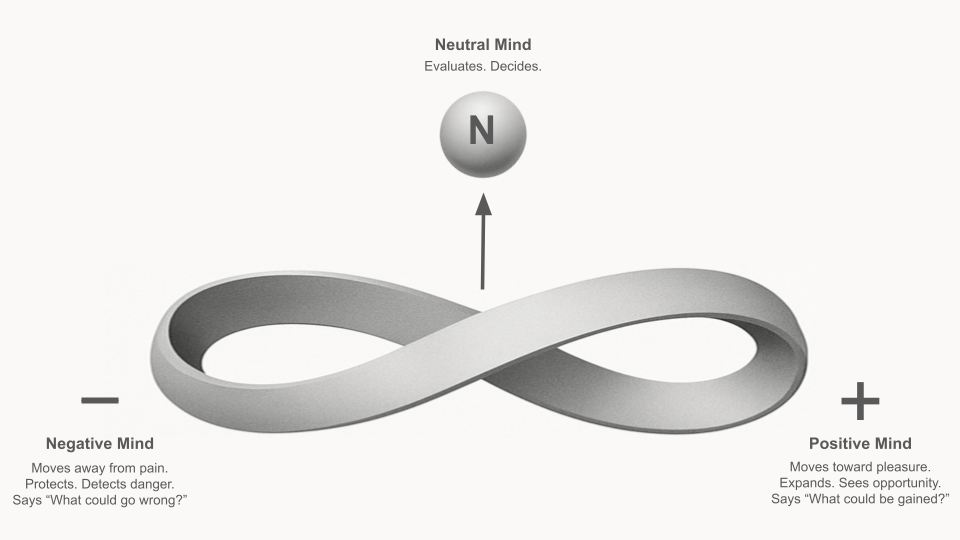
The two-mind, pain/pleasure model is incomplete.
There's a third mind.
The Neutral Mind doesn't just observe the war.
It ends it.
I discovered it before I had words for it. Not in the yogi’s living room. In a bathroom. Afternoon light through the window. When I was only five years old.
Imagine a volume dial with no upper limit. Not of sound. Of mass. Of density. Someone turning it slowly. No rush. The weight arriving in increments — pressing down from above, thickening the air, filling the room, filling you — getting bigger as you get smaller, heavier as you get lower, until you are gone and it's still going.
And you are five years old.
You don't know what's happening. You have no word for it, no framework for it, no adult in the world who knows it's occurring. There is no ceiling to it. No walls. No bottom. It doesn't sit on you and stop — it just keeps going. Keeps turning. The dial has no upper limit. It is not interested in your terror. Doesn’t care that you’re a child.
It goes until you are gone.
Maybe you run screaming in terror. Maybe you pass out from fear. Maybe you just lie there whimpering until you fall asleep. And then it's gone. Not because you did anything. Because it decided you weren't done yet.
And then a normal afternoon resumes. Sunlight through the window. The sound of the house. Like nothing happened.
Until the next time.
That was my childhood. Five years old. Eight years old. Ten. Not fear. Fear has an object. Fear is your father folding the belt in half, one hand on each end, snapping it slowly, repeatedly, deliberately — until you bent over to take the hits.
Fear you can name and work around.
This was dread. Uncontained. Pure. Sourceless. Infinite. Expanding. No object. No exit. No limit.
I never told anyone. Not one person on earth. Because what words does a child have for something like that?
You don't say it. You carry it. You get very good at carrying it.
I carried it alone for seven years.
One afternoon — I was twelve — I felt one coming again. I don't know where I found the courage. But that time I didn't run. Didn't hide. Didn't curl up and wait for it to finish.
I looked up. Faced it.
And one thought came:
I'm making these.
Not — something is happening to me.
I am building this.
The moment I saw that, they vanished. Completely. Never came back.
Somehow, when I saw I was responsible for terrorizing myself, I realized there wasn’t any reason to.
I didn't know what I'd found. It would be 30 years before I had a name for it.
The Neutral Mind. The observer. The part that can rise above the war and see it clearly.
There in me at twelve. There in you today.
The Three Minds
The Positive Mind is the accelerator. The part of you that sees what's possible, moves toward what it wants, drives forward. It isn't reckless — it's intelligent. It's been fighting for you your entire life.
Operating from the Positive Mind alone is like driving with only a gas pedal. No brakes. You accelerate without seeing the cliff.
The Negative Mind is the brake. It sees risk. It registers cost. It fires warnings and protects assets. It's not weakness or fear — it's your survival mechanism doing its job. And because survival always trumps optimization, the Negative Mind is faster. Under pressure, fatigue, or threat, it fires first.
Operating from the Negative Mind alone is like driving with only brakes. You never move. Paralysis. Shame spirals. All warning, no direction.
Most high-performing men live in the crossfire between these two — or worse, locked permanently into one of them.
The Positive Mind charging forward with no guardrail. The Negative Mind screaming warnings that never resolve into action.
Neither position produces clarity. Both produce cost.
The Neutral Mind is the third position.
Sovereign ground above the battlefield.
It doesn't suppress either voice — it hears both, integrates both, and issues a decision from a place neither side can contaminate.
This is what the Switzerland Method trains you to access. On demand. Under pressure. In real time.
When you do — the war ends. Not because one side won. Because command was finally established.
But here's what most men miss:
The Forged Identity thinks it can access neutral ground. It can't. Even when it's being rational — even when it sounds calm and measured and logical — it's still calibrated to performance. Its version of neutral still leans toward what it was built to accomplish.
It sounds like logic when it says "we can't slow down now" — but it's actually ungoverned drive. Replaying the script it wrote to keep you strong.
The Default Identity does the same thing. Even when it's being rational — even when it sounds like wisdom — it's still calibrated to avoiding old pain. Its version of neutral still leans away from what it learned to fear.
It sounds like wisdom when it says "this isn't worth the risk" — but it's actually ungoverned caution. Replaying the script it wrote to keep you safe.
Both think they are centered. Neither actually is.
Only one identity can access true neutral ground.
The Core Identity. The fixed point. The part of you that was there before the forge started — and the only part coming from somewhere true.
The part that knows what you must do and what you must never do — not because it was taught, but because it has always known.
This is why the Switzerland Method isn't just a decision-making tool. It's an identity tool.
The Sequence doesn't just help you think more clearly. It gives your Core Identity access to command — which is the only place a real decision can come from.
Consider Muhammad Ali in 1967.
At the peak of his career. Undisputed heavyweight champion of the world.
Everything he'd built was at its highest point.
Then the draft notice arrived.
The Forged Identity had everything to lose — the title, the income, the career, potentially his freedom. Every external pressure pointed toward compliance or compromise. Find a way. Play the game. Protect what you've built.
The Default Identity had every justification to fold — the fear was real, the cost was real, the institutional power arrayed against him was real.
Ali went somewhere else entirely.
He didn't rage. He didn't perform. He didn't negotiate with himself in public. He went to neutral ground, heard both sides clearly, and came back with a decision that could only have come from his Core Identity.
"I ain't got no quarrel with them Vietcong."
One sentence. The decision made. The cost accepted. The Code intact.
He lost the title. Lost three and a half years of his prime. Was convicted and faced five years in prison before the Supreme Court overturned the decision.
The Forged Identity paid an enormous price. But the Core Identity never moved.
That's Switzerland.
Part 4: The Code
The gap doesn't close itself. Not with discipline. Not with willpower. Not with better habits.
There's only one thing that closes it.
A Code.
A Code is not a set of rules imposed from outside. Not a list of virtues someone else handed you. Not a personality framework or a values exercise or anything you've done in a corporate offsite.
Your Code is your Core Identity made operational.
The forge, the structure, the architecture that determines the way you walk the earth.
It's the answer to two questions:
What must I do?
And what must I never do?
Not who you're trying to be. Not who you think you should be. Not who the performance requires you to be.
Who you are.
At the fixed point. At the north star. At the place that doesn't move.
Consider Marcus Aurelius. Emperor of Rome. The most powerful man on earth. Commander of armies, architect of law, ruler of an empire spanning three continents.
Every morning, before the world made its demands, he wrote in a private journal that was never meant to be read. Not policy. Not philosophy for public consumption.
His terms.
The man he decided to be.
The lines he would not cross.
What he must do.
What he must never do.
He called no one to witness it. He sought no approval for it. He simply returned to it — daily, deliberately — because he knew that without a fixed point, the weight of empire would pull him in whatever direction the day demanded.
The Meditations weren't written for us. They were written for him.
Here's mine.
I've been reciting this out loud every morning for eight months. Before anything else moves.
What's the Code?
Be useful.
Be response-able.
Respect yourself.
Develop meaningful connections.
Be grateful.
What's the Sacred Homie Vow?
I will not overcomplicate things.
What's the mantra?
Do it now.
Why do we have the Code?
To prepare for challenges and opportunities.
The thing about challenges and opportunities is they are not personal, permanent, or pervasive.
What skills do we need?
Pattern recognition.
Pattern utilization.
Pattern creation.
Where do we start?
State-management.
Patterns of physiology.
Patterns of language.
Patterns of meaning.
Patterns of focus.
How do we start?
Take The Helm.
Combat breathing.
Do it now.
Breathe, Baby.
This moment.
Now. Here.
Suspend this precious breath.
Hold Fast.
Why do we do we practice everyday?
To remember who we are and what we are committed to.
The character. Traits. Values.
Identity. Context.
Our way to walk the earth.
Why does it matter?
We must continuously calibrate our way of being to achieve our desired outcomes.
Right now our biggest outcome is: (confidential).
Our next milestone is: (confidential).
What has to happen?
There are 20 traits that making getting what we want inevitable.
Until reaching our next milestone, these 5 first:
- Radical honesty.
- Decisive action over comfortable ambiguity.
- Self-accountability.
- Uncomfortable courage.
- Systematic information architecture.
What is possible from neutral ground today?
What actually moves the needle?
(Example) Sharing the report.
Who's The Man?
I'm The Man. The Man Who Stops Pretending. The Teacher. The Guide. The Master. The Expert Identity Calibrator. The Dad. The Son. The Brother. The Man Who Tells The Truth. The man who writes the Code for men who rule the world.
LFG.
Here's what it looks like for me in practice.
Every morning. First thought comes automatically.
While I'm still in bed. If it doesn't, I say it:
Remember. I am The Man Who Stops Pretending.
I get up, grab the unfinished bottle of water beside my bed, take a swig.
Walk out onto the deck. If it's cold or raining, I grab a jacket.
I'm blessed with mountain air and lake views.
A couple of deep breaths and it's easy to quickly feel refreshed.
I start my Qigong Improv.
Just moving and stretching in ways that keep me flexible.
Fixed. And Fluid.
Flow state.
I recite the Code.
By the time I get to Combat Breathing, my right foot is up on the railing. I'm going deeper into hamstring stretches.
Going deeper into my body and the Code, I steadily amp the energy. Fulling associating to the feelings. The Captain at the helm — loving the ocean spray. The Wizard conjuring the heavens. The King, Lover, Warrior. The Best Junior Camper.
I play full out.
By the time I hit the last line, LFG! I am fully stoked.
I drink some more water.
Walk into my office. Check my dashboard. I'm ready to win the day.
I recite my Code again a few hours later when I take Max out for his morning walk.
Through repetition, I am conscious of my way of being throughout the day.
Parts of my Code automatically show up when I need them.
My work requires I spend a lot of time at my desk or on my phone.
When challenges and opportunities arise, my Code keeps me highly attuned to my way of being.
I take frequent body-breaks throughout the day.
In between highly focused work periods to keep myself strong and healthy.
I notice more and more when I'm making decisions from the Core.
I notice more and more when my mind defaults to shit that doesn’t serve me, or forges ahead unchecked.
Each day I log the evidence.
Anchoring the man I am becoming.
Grounding myself in truth.
My truth.
Listen.
There is no universal Code.
You can't take someone else's and make it stick.
No framework can hand you one pre-built and ready to use.
Because a Code that isn't yours won't hold. Not when it counts. Not at 2 AM. Not when the pressure is real and the performance has stopped and something older, faster is trying to take over.
The only Code that holds is the one you found yourself. Wrote yourself. Declared yourself.
And have practiced — daily, deliberately, over time — until it isn't a rule you follow.
Until it's the man you are.
Part 5. Case Studies
Example 1) Joe Removing Fish Hooks.
Let me show you what it looks like when a man without a Code finally finds his way.
A month ago I got a call from "Joe."
The name is changed. Everything else, exactly as it happened.
Joe's a real estate developer. 65 years old. Successful by every external measure. I've known him for ten years. In that time he's paid me over $100,000 for occasional consults. But he'd always balked when I recommended the full intense immersion.
And every couple of years — same pattern. He'd get it together for a while. Then relapse. Woman. Alcohol. Xanax. Seroquel. Ambien. Smoking. Repeat.
This time he'd been drinking heavily for two weeks straight.
Over a woman. Again.
When I asked him what it felt like — making the same decisions over and over, knowing what was coming but unable to stop it — here's what he said:
"Like a scratch pad on my soul, but more metallic. Not like a copper scour pad. Sharper. Like if you took paper and put a million fish hooks in it and it's always inside of me and I can never get it out."
Jesus.
That is what it actually feels like when you're living without a Code. Day after day after day.
Not uncomfortable. Not frustrating. Not some sanitized version of pain.
Relentless. Inescapable. Tearing at you from the inside out.
Joe had capability. Extraordinary capability. Multiple seven figures. Respected in his industry. The Forged Identity was intact — he could build, he could perform, he could deliver.
But he didn't have a Code.
And without one — he was making decisions based on whatever felt good in the moment. Whatever was convenient. Whatever the Default Identity was running from.
The pattern had been running him for more than 60 years.
I talked him down enough to get him on a plane. "Book a flight to Seattle. I'll pick you up at the airport. We'll spend five days together."
He said: "I don't think I can. Let's wait until I've stopped drinking."
"Joe — you've been telling me that every day for days. Right now you're at least coherent. But you're moving in the wrong direction. Every day you're drinking more. Not less."
"It's true. You're right."
Then I asked him the question that changes everything:
"How much has waiting already cost you? Even in the last ten years?"
He groaned. Almost hauntingly. Like a ghost. Like I'd actually punched him in the soul.
"Fuck, man, do you really want to know? Even in the last few months..."
"Exactly. What was her name? Lynn?"
"Yeah."
"Right there. $400,000. Just in a few months."
He didn't say anything after that.
He booked the flight.
For ten years I'd been telling him the same thing: it's not a drinking problem. It's a thinking problem.
Joe always agreed. But he never really got the source.
The substances, the women, the chaos — symptoms. Not the cause.
The cause was the operating system underneath. The Default Identity running the same pattern in different costumes.
But for ten years I didn't have the framework to show him why the thinking was the way it was.
I could point at it. Name it. Help him manage it temporarily.
I couldn't give him the context to see it clearly enough to change it permanently.
Until Seattle.
This time I showed him the Three Identities. Core. Forged. Default.
Something clicked that had never clicked before.
Now he had the framework. Now he could see which identity was generating which thoughts — and why the Default Identity kept winning even when the Forged Identity was performing at the highest level.
We built the first version of his Code.
The seed. The stake in the ground. Not perfect. But honest. Real enough to calibrate against.
Because you can't calibrate without a fixed point — and for ten years, he didn't have one.
Here's what his first version looks like:
THE CODE (Recite by heart every day)
What's The Code? Move my body daily. Be responsible. Eat to heal. Hold my standards. Show up as The Match.
What's The Vow? I will not numb out or settle. I'll be the best that I can be.
What's The Mantra? This body heals. This life improves. I do the work.
THE FRAMEWORK: 4 Patterns I Control
Pattern of Physiology — Movement, nutrition, sobriety. My body responds to what I give it.
Pattern of Language — How I talk to myself and about myself. "I'm healing, I'm quality, I'm going to kick ass mother fucker!"
Pattern of Meaning — Chronic pain is feedback, not failure. Low-quality women were lessons, future women will reciprocate and elevate.
Pattern of Focus — Where attention goes, energy flows. I focus on being, not just wanting.
IDENTITY CALIBRATION
(I do this every day to remember and reset who I am, how I'm being, and what I am committed to.)
I am a man who heals himself. I am a man who keeps his word. I am a man worthy of a high-quality woman because I hold myself to high-quality standards. I am becoming pain-free, strong, clear, and magnetic. I am a high-quality man. I'm a father. I'm a responsible businessman. I'm a builder.
THE CORE (Read every day until I achieve my outcomes)
What Are My Outcomes? I'm in a long-term committed relationship with a wholesome woman. I'm healthier than ever and my sciatica is completely healed.
That's not theory.
That's not a mission statement someone else wrote.
That's Joe's actual Code.
The Core Identity made operational.
What he must do. What he must never do.
The fixed point he calibrates against — daily, deliberately — so the Default Identity doesn't take over when the pressure is real.
Three weeks later:
Drinking? Not a problem.
Serial dating? Done.
Sciatica? Improving daily.
Integrity? Power? Self-respect? More than he's felt in decades.
He's reciting his Code every morning. Out loud.
Keeping his own evidence log. Walking. Stretching. Doing his mobility work.
And for the first time in ten years, I'm certain he isn't going to relapse.
Because this time he's not managing symptoms. He's operating from the Core.
The fish hooks are finally coming out.
Example 2) A Tale of Two Codes
Thirty years ago, my friend Woody and I both discovered Tony Robbins’ concept of an incantation—a daily practice of reciting core truths about your identity.
We each wrote our own.
Woody’s began: “The purpose of my life is to be a passionate, loving, outrageously kind soul.”
Mine began: “The power of creation flows through my veins. I was born to lead, to bring massive change.”
I can still remember those words thirty years later.
But after a few weeks, I stopped.
Woody didn’t. He recited his every single day for thirty years.
We were both running businesses.
Woody had a single La-Z-Boy franchise doing about a million a year.
I had built The Red Balloon—24-hour childcare centres. Three locations doing about $500,000 per year, a fourth in the works, plus our first franchisee ready to commit.
I built those centres for my own kids, so they could be surrounded by other children in the best environment I knew how to create.
They were extraordinary. And they took off.
We were also both investing in the stock market.
Woody always used strict stop losses.
I didn’t.
About a year later, I went bankrupt. Margin calls.
I sold The Red Balloon. One location is still standing today.
But the regret isn’t just the income, or even the loss of a business that I loved.
It’s the legacy I walked away from.
Those centres came from my soul. They were a work of art.
And when I think about the sub-standard care all those kids got after I sold, it really makes me sad.
That business would have scaled.
But I had no anchor. My relationship was falling apart. I had no place to stand.
Woody stayed focused.
He sold his La-Z-Boy store and bought his first Ashley Homestore franchise.
In 2003, he hired me to train his sales team.
Part of that meant writing the training manual.
By then, Woody had turned his personal incantation into something much bigger: The Ashley Code of Conduct.
It was mandatory for everyone. You couldn’t even enter training unless you could recite it.
The training was intense. Competition. Prizes. Memorization. Repetition. We weren’t playing around.
Every salesperson had to know, by heart, their Goal, Mission, Vision, Purpose, and the Ashley Code of Conduct—ten principles including: “There is always a way,” “No failures, only outcomes,” and “I give more than anyone expects.”
The result?
Today he has ten stores and at least a hundred salespeople—some of them writing a million dollars a year in a single store alone.
Then Woody created The No Matter Whats—codes for every department. Logistics. Customer service. Sales. Executive staff.
Everyone knew their non-negotiable standards.
That’s the difference.
A daily Code isn’t motivational. It’s foundational.
Woody practiced his Code daily, and eventually it flowed through his entire organization.
I abandoned mine, and when distraction came, I had nothing anchoring me.
One of the salesmen I trained, Kevin, eventually became Woody’s CEO.
If he knew I’d abandoned my own Code back then, he’d probably shake his head and say, “That’s why we didn’t go with you on that software thing. On some level I must have known you were full of shit.”
And he’d be right.
Today, Woody built something sustainable—an organization full of million-dollar producers and a CEO who came up through the ranks. Now his empire practically runs itself.
That’s the power of your Code lived daily.
And the price of abandoning it.
The Source
This morning in the bathroom, I found it.
Not another iteration of the Code. Not a better way to say it.
The actual source.
For fifty years, the fixed point I've been calibrating from without even knowing it.
I've written several versions of this document. Each one circling closer.
Each one naming the gap, showing the cost, building the framework.
But I hadn't gone back to the beginning.
Not the beginning of the problem — the beginning of me.
Before the Default Identity wrote its script. Before the Forged Identity started performing. Before the gap opened.
The moment the Core Identity was absolute. Unfuckable with. Mine.
I was nine years old.
Summer camp. Camp Kitchikewana. Second year.
The camp motto was "To be the best that we can ever be." I'd heard it the year before when I was eight. It sounded important. Noble. True.
But a motto isn't an identity.
It's pointing at something. Suggesting something. Asking you to reach for something.
At nine years old, I stopped reaching.
I arrived.
End of summer. Final night. The awards.
John Jakes — section head, the kind of man a nine-year-old boy looks up to without question — called my name.
He handed me a leather shield. About eight by ten inches. Three words burned into the leather. Jakes bellowed them out loud.
Best Junior Camper.
I looked at that shield and something locked into place.
Not "I'm trying to be the best."
Not "I hope I'm good enough."
I am the Best Junior Camper.
Absolute. Complete. True.
That wasn't aspiration. That was evidence.
The kind of evidence that doesn't require explanation or defense. The kind a nine-year-old boy can hold in his hands and know — without doubt, without performance, without needing anyone else to confirm it — this is who I am.
I had a Core Identity.
Fixed. Precise. Mine.
What I didn't have was a Code to carry it forward.
The camp motto — "be the best that we can ever be" — wasn't enough.
It told me what to aim for. It didn't tell me how to protect what I'd already become.
It didn't say:
When the water looks too cold and your legs want to turn around — you get in anyway. Because that's what the Best Junior Camper does.
When something matters and the risk of failing feels unbearable — you do it anyway. Because pretending it doesn't matter is pretending you're not him.
When the Default Identity offers you a story that makes walking away feel reasonable — you recognize it for what it is. And you stay.
I didn't have that Code.
So I took the shield home at the end of summer. Proud. Certain.
And then I stepped back into a world, and to a father, who had no idea what to do with a nine-year-old boy who knew exactly who he was.
Five years later I was fourteen.
Standing on a beach at the same camp. Looking at the water.
The Newton Award. Best Senior Camper. The thing I was supposed to win. Everyone knew it.
To get it, I needed the Bronze Cross. To get the Bronze Cross, I had to swim the laps.
I looked at the distance between the docks.
And my legs turned me around.
Somewhere on the walk back to the cabin, a story arrived — quiet, reasonable, completely convincing:
It doesn’t matter anyway.
That became my operating system.
The Default Identity's first major installation.
Here's what I didn't see until this morning.
For fifty years I wasn't pretending to be better than I was.
I was pretending to be less than I was.
I was pretending I wasn't the Best Junior Camper.
I'd forgotten the shield. Or decided it didn't count. Or let the world convince me that what a nine-year-old boy knew about himself couldn't possibly still be true half a century later.
From that kid's perspective — the one holding the shield, the one who knew who he was, absolute and unfuckable with — many of my life choices would have been incomprehensible.
The women who didn't match. The business ventures that didn't align. The drugs, the alcohol, the chaos. The pattern of choosing people and situations that required me to forget who I actually was.
None of that makes sense to a kid who knows he's the Best Junior Camper.
Because when you know who you are — really know it, the way that nine-year-old knew it — you don't make decisions that contradict it.
You don't choose relationships that require you to perform a different version of yourself.
You don't build a life that only works if you pretend the Core Identity doesn't exist.
You don't spend fifty years running a Forged Identity on top and a Default Identity underneath, while the actual you — the one with the shield — watches from somewhere so deep you've almost forgotten he is there.
Until that last-straw-what-the-fuck moment.
This morning. In the bathroom.
I gotta call my mom. Tell her the truth. Probably even apologize. Tell her to stop worrying.
Tell her for decades I have kept her on the hook. Pretending I was unhappier, less successful, less than everything that I really was.
Not because I was protecting her. Because I was protecting the lie.
The lie that the kid with the shield didn't matter anymore. That who I actually was didn't count. That I could build a life from anywhere except the truth.
So here's the real Code.
Not the one I wrote for the morning walks with Max. That one's good. That one's real. That one works.
But underneath it — before it — is the Code I should have written at nine years old:
I am the Best Junior Camper.
Not "I was." Not "I used to be."
I am.
And everything I build, every decision I make, every relationship I choose, every system I create — it all has to match that.
Not because I'm arrogant. Because I'm honest.
Because the Core Identity doesn't disappear just because you stopped listening to it.
It just watches. And waits. And sends signals.
Until you finally remember who the fuck you actually are.
And now that I've seen it — now that I've gone back to the actual source — maybe it's time to update the Code I've been reciting every morning.
Not replace it. Recalibrate it.
Because the shield isn't separate from what I have been building. It's the foundation.
Here's my latest calibration:
Remember.
The Man Who Stops Pretending.
I am the Best Junior Camper.
That is where “I” began.
That boy. This man.
What’s the Code?
Be useful.
Be response-able.
Respect yourself.
Develop meaningful connections.
Be grateful.
What's the Sacred Homie Vow?
I will not overcomplicate things.
What's the mantra?
Do it now...
That's it.
Source Code added.
At the top. Where it should have been all along.
Not because I'm trying to prove anything.
Because the kid with the shield doesn't disappear just because I forgot he was there.
He's still there. He's always been there.
And now everything I build has to match that.
Because now I am The Man Who Stops Pretending.
Found. Written. Declared.
Part 6: The Five Forges
Character isn't built through willpower. It's forged in fire. Daily.
Specific territories where who you actually are gets tested until it's permanent.
Not a checklist. Not a phase. A daily practice. For life.
The musician never stops playing scales — not because he can't perform.
Because the scales keep the music true.
1. The Forge of the Body — Sovereignty of State
1975. Back of a comic book. Charles Atlas. "The Insult that Made a Man out of Mac."
A 97-pound weakling. Sand kicked in his face. The girl watching.
I was eleven. I wasn't interested in the girl. I wasn't even interested in the bully.
I wanted to be strong. I had reasons. They were mine.
That was the Core Identity speaking — at eleven, before I had language for it.
The body has been a daily practice ever since.
Your body is not separate from your identity. It is the instrument your identity operates through.
When the body is neglected — depleted, dysregulated, running on stimulants and willpower — the Default Identity gets louder. The Forged Identity compensates harder. The Core goes quiet.
You cannot access who you actually are from a body that's been abandoned.
Calibration question: This week, did my body serve my Code — or did I abandon it?
2. The Forge of Silence — Sovereignty of Mind
For years I told clients: Physiology first. Master your breathing, master your universe.
I wasn't doing it.
So I took it on. Breath-holding. Every time I tried, my mind panicked and shut it down. Thirty seconds and it was over. For weeks.
Then Alabama. Working with a client. One of his managers was a free-diver. I asked how he dealt with the panic.
He said: think about making a peanut butter sandwich.
The next day I tried it. Set my timer. Closed my eyes. Stopped breathing.
Started making the sandwich.
But not in some abstract kitchen — I went back to my grandfather's cottage on Stoney Lake. The countertop where my grandmother used to make them.
I was there. Completely real.
Then something shifted. A thought arrived — quiet, unhurried.
Wait. Why am I making a sandwich? Why don't I just go paddle the canoe?
So I went. Still not breathing. Eyes still closed.
Pine floor beneath my feet. Fireplace to the left. Gram's blue leather chair ahead. Door to the porch on the right. Steel of the door knob. Four steps to the grass. The path to the boathouse. The ropes, suspending the canoe from the rafters.
Lowered the stern. Lowered the bow. Portaged out. Went back for the paddle. Slipped the canoe into the water. Pushed off. Began to paddle.
Left the dock. Passed the Young's dock. The Huff's cottage on the left. Jay stroke. Water dripping from the paddle on the swing.
I close my eyes.
Hear a loon.
Eyes open.
3 minutes 22 seconds.
I hadn't silenced my mind. I hadn't fought it. I'd given it somewhere so completely real to go that there was no room left for panic.
And once the noise was gone, something else became possible — a decision, made quietly, from somewhere underneath the performance.
That's the Forge of Silence.
Not meditation performed correctly. Not the absence of noise.
Finding a place so real inside yourself that performance has nowhere to stand — and discovering that in that stillness, the Core Identity doesn't just survive. It decides. Never mind the sandwich. Paddle the canoe.
Calibration question: This week, did silence reveal something true — or did I just perform stillness?
3. The Forge of Standards — Sovereignty of Action
Camp Kitchikewana. Summer 1978. Fourteen years old. The Newton Award. Best Senior Camper. The thing I was supposed to win. Everyone knew it.
To get it, you needed the Bronze Cross. To get the Bronze Cross, you had to swim the laps.
First morning. I walked down to the beach and looked at the water. Looked at the distance between the docks.
And my legs turned me around.
Walked back to the cabin.
And somewhere on the way, a story arrived — quiet, reasonable, completely convincing:
It didn't matter anyway.
But it mattered to my friend Mike Elrick.
Mike got in the water. Won the Newton Award. I watched him accept it — not bitter, not resentful. He was great. He deserved it. I was genuinely happy for him.
And ashamed.
The specific shame of a boy who had just talked himself out of his own life.
That story — it didn't matter anyway — became the move. Ran my life for decades. The default. The thing I reached for every time something mattered too much and the risk of failing felt bigger than the cost of not trying.
Mike Elrick went on to become Senior Staff. Then Camp Director — the role I'd always wanted, applied for, never got. Mike built a life of exactly the kind of integrity the Newton Award suggested he would.
He died November 23, 2009. He was forty-six years old.
He was the version of me that got in the water. I was still standing on the beach.
The Forge of Standards isn't about catastrophic failures. Not the ones where someone was watching and the cost was visible.
It's the beach moments. Where no one made you turn around. Where the story arrived so quietly and reasonably you almost didn't notice it wasn't true. Where the Default Identity didn't announce itself — just turned your legs around and handed you something to say on the way back to the cabin.
The Forge of Standards is simple. Not easy — simple.
Your word to yourself becomes inviolate. Not because you're trying to be perfect. Because you've decided who you are.
The man you've decided to be gets into the water. Does whatever is required.
Calibration question: This week, did I do what was required?
4. The Forge of Connection — Sovereignty of Intimacy
This is the forge high-performing men avoid most. Because it's the one where the Forged Identity has no advantage and the Default Identity has the most to lose.
The Forged doesn't want to be known. It needs to perform.
The Default doesn't want to be known. It's protecting itself.
But the Core Identity requires being seen and known by at least one other human being — without performance, without armor.
Most men — especially successful ones — operate in intimacy the same way they operate in business. Transactionally. They show up. They perform. They deliver value. They expect a return.
And when the return doesn't come — when the woman pulls away, when the kid shuts down, when the friend goes cold — they either optimize harder or withdraw completely.
Neither works. Because intimacy isn't a transaction.
The other forges respond to discipline. Repetition. Will.
This one doesn't.
You can't perform your way into intimacy. You can't discipline your way into trust.
Intimacy isn't about what you do. It's about what you're willing to feel without needing to fix it, control it, or make it go away.
Sovereignty over intimacy means you can stay present with someone else's truth — their fear, their pain, their chaos — without making it about you.
You don't need them to be different so you can feel safe. You don't need them to validate you so you can feel worthy. You don't need them to perform so you can feel successful. You don't even need them to be honest so you can assess.
You just stay. Fully present. Fully open. Fully sovereign.
Once a week, sit with someone you love and ask them one question:
"What's something you're carrying that you haven't told me about?"
Then shut up. Don't respond. Don't fix. Don't reassure. Don't problem-solve.
Just. Listen.
And here's the hard part:
Whatever they say — no matter how uncomfortable, how unfair, how wrong it feels — you don't defend yourself. You don't explain. You don't correct. You don't make it about you.
You just say: "Thank you for telling me."
That's it.
Because the moment someone tells you something vulnerable, your Default Identity will immediately try to protect you.
It'll say: "That's not fair." "They don't understand." "I need to explain." "I need to fix this."
And you Forged Identity will start making up solutions: “Say it.” “Go there.” “Do this.” “Try That.”
And the moment you act on any of those impulses? You've just proven to them that you can't handle their truth.
So they'll stop giving it to you.
But if you can stay present — if you can hear their truth without needing to defend, explain, or fix — you've just done something most men will never do.
You've shown them it's safe to be real with you.
And that's when intimacy actually begins.
Calibration question: This week, did I stay present with their truth — or did I make it about me?
5. The Forge of the Code — Sovereignty of Identity
This is the forge that holds all the others together.
April 4, 2025. Max Aurelian Highstead born.
May 14. Wilson — my dog — had to be put down.
The morning walks continued. Just me now.
Then not just me — Max, in the stroller, two or three months old.
I'd walk and talk. Think about Wilson. Think about Max. Think about Jonathan, thirty-four years old, not speaking to me.
Wonder what I would say to Max when he was old enough to hear it.
Wonder what I should have said to Jonathan when he was young enough for it to matter.
Victoria told me what she wanted for our son.
Not "I want him to be happy" — the line my mother gave me, the seed of a life spent optimizing for comfort.
She said: "I just want him to be useful."
That word landed differently.
July 14, 2025. I wrote the first iteration of my Code.
No promises or commitments yet. No calibrated patterns. Just remembering how to be.
Started saying them out loud on the morning walks. To Max.
What's our Code?
Be Useful.
Be responsible.
Respect myself.
Develop meaningful connections.
Be grateful.
Then one day — he was five, maybe six months old — I said something I'd never said to my thirty-four-year-old son:
"You will live by my Code until I am certain you have replaced it with your own."
Hadn't planned it. It arrived the way paddling the canoe arrived — quiet, unhurried, from somewhere deep below the surface.
That's the Forge of the Code.
Every morning. Before the day takes over. Out loud.
Not reciting words. Not a morning ritual performed correctly.
The moment the Code stops being aspiration and becomes identity.
When you say it out loud — to your infant son on a morning walk, to the empty room, to yourself in the mirror — not as something you're trying to become.
As something you already are.
The fixed point. The part of you that doesn't move. The truth of your identity.
Calibration question: This week, did I live from the Code — or just recite it?
Part 7: The Switzerland Method
I didn't build The Switzerland Method from theory. I built it from the wreckage.
If someone had shown me this at twenty — not handed me a Code, but shown me that I needed one, and given me the process to find and live by it — my whole life would have been different.
The gap never would have opened.
The Default Identity never would have found its way in.
I can't go back.
Neither can you.
All we can do is close the gap from here.
Not someday. Now.
The governing question of the entire method is this:
How do I continuously calibrate my way of being to achieve my desired outcomes?
Same question. One man alone at 5am. Or a founding team before a decision that defines the company.
A family. Or a nation.
The unit changes. The question doesn't.
The Switzerland Method moves through five levels.
Each has a gateway question that must be answered from your own experience.
Answer honestly and the next level opens. Bullshit yourself and you stay stuck.
Level 0: The Code
Gateway question: What are my terms? What must I do? What must I never do?
Before either of those questions can be answered honestly — one commitment that makes everything else possible:
All I have to do is tell myself the truth.
You cannot calibrate without a fixed point to calibrate against.
Your Code at Level 0 doesn't have to be perfect. It has to be honest.
A stake in the ground. The truth of who you are and what you stand for — precise enough to calibrate against, real enough to hold under pressure.
You've already seen what that looks like. Mine. Doug's. Both built the same way — not handed down, not invented.
Found. Written. Declared.
Level 1: Take The Helm
Gateway question: Who is responsible?
Before anything moves, a man has to reclaim sovereignty over his own life. Not responsibility as obligation — but the ability to respond in ways that actually work.
The Signal arrives first. That involuntary moment of clarity. The crack in the armor. The quiet voice that says something here isn't right.
The WTF moment — whether it came as a headline, a call, a look on your kid's face, or just a Tuesday morning when the performance stopped and something older was running the show.
The Declaration follows.
The conscious response.
The moment the involuntary crack becomes a deliberate choice.
I am responsible. I've got the helm.
Robert Downey Jr. had his Signal in a stranger's house. Passed out in a child's bed. Woke up not knowing whose house he was in, whose kid slept there, how he'd gotten through the door.
That was the Signal.
What followed was one of the most documented human comebacks in modern history. Not because he got lucky. Because the Signal was real and his Declaration matched it.
He took the helm. He stayed at the helm.
And the Default Identity that had been running him for decades finally lost command.
Level 2: The Integrity Audit
Gateway question: What's not working?
You already know the answer. Not the polished version you'd give someone else. The real one. The one you don't say out loud.
The Integrity Audit names the conflict precisely. Not as a vague feeling — as a statement of two incompatible truths held simultaneously.
Tiger Woods held himself to the highest possible standard as an athlete. He held himself to a completely different standard as a man.
That's the gap. Named. Located. No longer anywhere to hide from it.
Where are you world-class — and where are you bullshitting yourself?
You cannot calibrate what you haven't located.
Level 3: Switzerland
Gateway question: What is possible from neutral ground?
This is where the Core Identity takes command. Not by silencing the Forged or the Default. By rising above the battlefield far enough to hear what both are actually trying to protect — and making a decision from who you wanted to be all along.
You've already seen what this looks like. Ali in 1967. The decision that could only come from the Core.
The Switzerland Sequence is the practical tool for accessing that ground. It moves through six steps:
1. Physiological Reset
Combat breathing to interrupt the Default Identity's control of your nervous system.
2. Externalize Both Voices
Write out what the Forged Identity wants and what the Default Identity fears. Get them out of your head and onto paper where you can see them clearly.
3. Identify The Protection
Name what each identity is actually protecting. Not what it says it wants — what it's trying to keep safe.
4. Step Into Neutral Ground
Physically stand up. Move to a different location. Access the observer position where neither identity has command.
5. Hear The Core
From neutral ground, ask: What does the man I wanted to be all along know is true?
6. Test The Voice (Humility Check)
Ask of the answer you heard:
Does this cost me something real (comfort, image, control), or only protect them?
If it doesn’t cost me anything, it’s not the Core. It’s the Default or Forged talking.
7. Issue The Decision
Declare it — out loud. From the Core. Then act immediately on the first step.
It feels like a technique the first time.
The tenth time, you realize the Core Identity has been trying to speak your entire life — and you finally gave it the floor.
By the hundredth time, Switzerland isn't somewhere you visit. It's where you operate from.
Level 4: Evidence
Gateway question: How will I know when this is completely solved?
Not managed. Solved.
Lance Armstrong managed his story for over a decade. Got better at it every year. The denials more polished, the narrative more airtight — until it collapsed.
Because management has no finish line. There's no moment where the managed story becomes true. There's only the next threat to manage.
The Evidence level sets the standard for what done actually looks like.
A courtroom-grade evidence file. Specific, observable, repeatable proof that the calibration is real — that the gap has closed, that the Default Identity no longer has access to the controls it used to run.
What would a jury need to see to believe the change is permanent?
Not your word. Not your intentions. Observable behavior. Repeated over time. Under pressure.
Suppression requires constant vigilance. Resolution requires none.
Level 5: Character
Gateway question: What traits make getting what I want inevitable?
The war is over. The Core Identity has taken command.
But when the war ends, a vacuum appears.
Nature always fills a vacuum.
If you don't fill it deliberately — with character built on the Core Identity — the old wiring returns. Dressed as a celebration. A reward you've earned. A reason to relax the standard.
So before you forge anything, you need to know what you're forging toward.
Start with the outcome. Not the industry definition of success. Yours. Specifically. What does winning actually look like — for this business, this life, this version of you?
Now work backwards.
What would have to be true — about you, your capabilities, your systems — for that result to be inevitable?
Not occasional. Not under ideal conditions. Inevitable.
This isn't just about character. Some requirements will be traits. Some will be skills. Some will be systems. Some will be about the people around you, the way your team operates, the conditions you've built to work in.
All of it counts.
Name everything. As many as required. My current outcome requires twenty. Yours may require more or less.
Keep asking: Is there anything missing? Is there anything else I need to make the result inevitable?
When the list feels complete — pick five to begin your forge.
Those five are your starting point. The Five Forges are how you build them.
Kobe Bryant had a Code. The Mamba Mentality was real, practiced, his. But it was a performance Code. Built for the court. No jurisdiction off it.
What happened in the years after Colorado matters as much as what happened before — because Kobe rebuilt deliberately. The Mamba Mentality started becoming something larger. A Code for living, not just competing. He was, by every account, mid-forge when the helicopter went down.
That's Level 5. Ending in the only place worth living.
Mid-forge.
Part 8: The Invitation
I'm not telling you this because I have it figured out.
I'm telling you because I know what it costs when you don't.
Fifty years running the wrong operating system.
Multiple failed businesses punctuated by extraordinary achievement and success.
Prison. Bankruptcy.
A beloved wife who killed herself.
If I’d had my Code, I wouldn’t have chosen her in the first place — no matter how beautiful, brilliant, and hilarious she was. I told myself her old-world money was important. And even if I had, I would have been a very different man — one who might have looked deeper, asked harder questions, and not left her alone with the pain that ended in her suicide.
Multiple failed relationships punctuated by memories of pure bliss.
Addictions. Estrangement from my friends and family.
Financial, physical, and emotional abandonment of my children in the fallout. A 38-year-old daughter who is still carrying weight I can’t even comprehend. A 34-year-old son who won't talk to me. And a one-year-old son with a good woman I chose for bad reasons.
All while pretending to be someone different than I really am.
Pretending it doesn't really matter anyway.
Pretending there's nothing I can do.
Pretending to be less than I am.
Patterns I saw echoing across generations with my boy broken and raging on the mountain.
This is the bill for fifty years without a Code.
If someone had shown me this when I was twenty — not handed me a Code, but shown me why I needed one, and given me the process to find, declare and live by it — my whole life would have been different.
I can’t change any of that. What I can do is show you the process I use now — in real time, under real pressure, with real consequences still unfolding.
You've read this far because you've felt it.
The gap. The cost. The quiet voice that says this isn't who I am.
Maybe it showed up as a last-straw-what-the-fuck moment you're still carrying. Maybe it's been building slowly for years — a low hum you've gotten very good at ignoring.
Either way, you know.
The cost is real. The gap is growing.
Not just your personal life. Your team. Your culture. Your systems. The decisions people make when you're not in the room.
The blind spot doesn't stay personal when you're operating at scale.
It exports itself. Into everything.
What This Actually Is
The Switzerland Method is a private, year-long partnership where we resolve all the internal conflicts causing your most costly external problems.
In that time we achieve one thing:
We close the gap between who you have become, what you are creating, and who you actually are.
We do that by answering one question for you and/or your team:
How do we continuously calibrate our way of being to achieve our desired outcomes?
Not through theory. Not through frameworks you perform for a quarter and forget.
Through Identity Calibration. Daily. Structural. Permanent.
We find your Code — not mine, not a template, yours — the one that's been there since before the performance started.
Then we make sure everything you're building actually reflects it.
Your body. Your mind. Your standards. Your relationships. Your leadership. Your organization.
Until the gap is closed and the Default Identity no longer has the controls.
I can't give you a Code. Nobody can.
But I can give you the process for finding it, testing it, anchoring it permanently — and then living from it under pressure instead of managing around it when the stakes are real.
How Calibration Works
First: Do you have a Code?
Not values on a wall. Not a mission statement someone else wrote.
Your Code. The Core Identity made operational. What you must do. What you must never do. The fixed point you calibrate against — daily, deliberately — so the Default Identity doesn't take over when the pressure is real.
Second: Are you living it?
Not performing it. Not managing around it. Actually operating from it.
In your body. In your mind. In your standards. In your relationships. In your leadership.
The Five Forges aren't theory. They're daily practice. And the evidence either proves the gap is closing — or it doesn't.
Third: Is your team operating from it?
Because if you've built a Code and you're living it — but your organization is still operating from the Default Identity you haven't addressed — the gap is growing.
It's in the culture now. In the hiring. In the decisions your team makes when you're not in the room.
The work scales. Not because we're trying to scale it. Because you can't build something significant without your Code — or your lack of one — showing up in everything you touch.
This isn't just about getting your personal life in order. It's about making sure everything you build — your team, your company, your systems — operates from Core, not Default.
So the work can be just you. Or it can be your entire leadership team.
It can be personal recalibration. Or it can be organizational transformation.
It depends on where the gap is — and what you're actually looking to build.
Who This Is For
This is only for men who:
Have already built something significant and know there's a gap between the man leading it and the man who started it.
Are operating at a scale where their blind spot doesn't just hurt them — it shapes systems, culture, and people who have no choice but to breathe that air.
Are done managing the gap and ready to close it.
Understand that real calibration takes time, repetition, and the willingness to go back to the source before the Default Identity wrote its script.
If that's you, book the call.
If not, that's fine too. This work is only for men who've reached the point where the cost of pretending is higher than the cost of changing.
What Happens Next
Book the call. It's a conversation, not a pitch.
You'll tell me your story. I'll tell you if I can help.
If it's right for both of us, we'll know. If it's not, I'll tell you that too.
One man. One Code. One year.
→ switzerlandmethod.ai/call
Mike Highstead
Founder, The Switzerland Method
Mid-forge. Like you.
© 2025 The Switzerland Method | Privacy Policy